Wiring
A New Porch Light on an Old Brownsville Circuit
A lot of our work in older Brownsville homes starts at the front door. The owner wants a brighter porch light, or one by the back steps for the dark evenings, and figures it is a quick fixture swap. Sometimes it is. Often the old fixture hangs off a circuit that also feeds half the house, with wiring behind it that is older than anything the new light expects. I am Brandon, and my son and I run Hub City Electric out of Albany. This is how we handle outdoor lighting on a house with heritage wiring, and what that small job tends to tell us about the rest.
What is usually behind the old fixture
Take down a porch light on a house this age and the box behind it tells the story. Sometimes it is knob-and-tube, the original wiring run on porcelain knobs through the walls and attic, still carrying power. Sometimes it is cloth-jacketed cable from a later update, brittle where years of summer heat reached it. Often there is no ground wire at all, and the box is a shallow metal can too small for a modern fixture and its connections.
Then we trace where it comes from. In a lot of older houses the porch light sits on the same circuit as a bedroom or the front room, because someone tapped the nearest wire decades ago. That is why the porch light flickers when the vacuum runs, and why a dead outlet in the hall can turn out to be a loose splice at the front door.
None of that is a reason to panic. It is a reason to open the box before buying the fixture.
Why outdoor lights deserve their own protected circuit
Anything mounted outside lives in rain, cold and the occasional wasp nest, and moisture finds its way into boxes over time. When an outdoor fixture or receptacle shares a circuit with the inside of the house, a problem out there can take down the lights where you are sitting. Giving the exterior its own circuit keeps a wet fixture from becoming an indoor mystery.
That new circuit also gets the protection a modern house expects. Outdoor receptacles get GFCI protection, which shuts power off fast when current leaks somewhere it should not, like through a damp cord or a person. Fixtures go into proper weather-rated boxes, sealed to the siding. And the circuit gets a clear label in the panel, so the next time something trips you know which breaker belongs to the porch instead of flipping them one by one in the dark. More of how we handle runs like this is on our Brownsville wiring services page.
The porch light is often the first circuit in an old house that anyone has looked at closely in a long time.
Getting a new run outside without wrecking the plaster
The hard part of a new outdoor circuit in a heritage home is the path from the panel to the front wall. Plaster does not forgive the way drywall does, and the trim around old doors and windows is usually the reason the owner bought the house.
So we plan the run before we cut anything. Most of the time the cable can travel through the attic or the crawl space and drop into the wall cavity behind the fixture, which means one small opening, sometimes none, inside the house. Where we do have to open plaster, we keep the hole small and in a spot that is easy to patch, away from original trim. We fish wire along existing cavities instead of cutting channels. On some houses the cleanest route comes up from below and out through the siding directly into the new box.
We talk through the route with you first, so you know where any opening will be before we make it.
What one porch job tells you about the house
Opening one exterior box is a small window into everything behind the walls. We see what kind of cable feeds the front of the house, how the splices in the attic were made and whether anyone before us added onto the circuit without a junction box. Most of the time the news is ordinary: a few tired splices, an ungrounded run, nothing that needs action this week. Now and then the porch circuit turns out to share a run with half the front rooms, and that is worth knowing before you add more load.
A porch light job is a good way to find out which kind of house you have without committing to anything. We see the wiring at the front wall, the splices in the attic and the condition of the panel, and we write down what we found. If the panel itself looks tired, our panel maintenance visits in Brownsville are the next sensible step.
The fixture, the switch and the siding
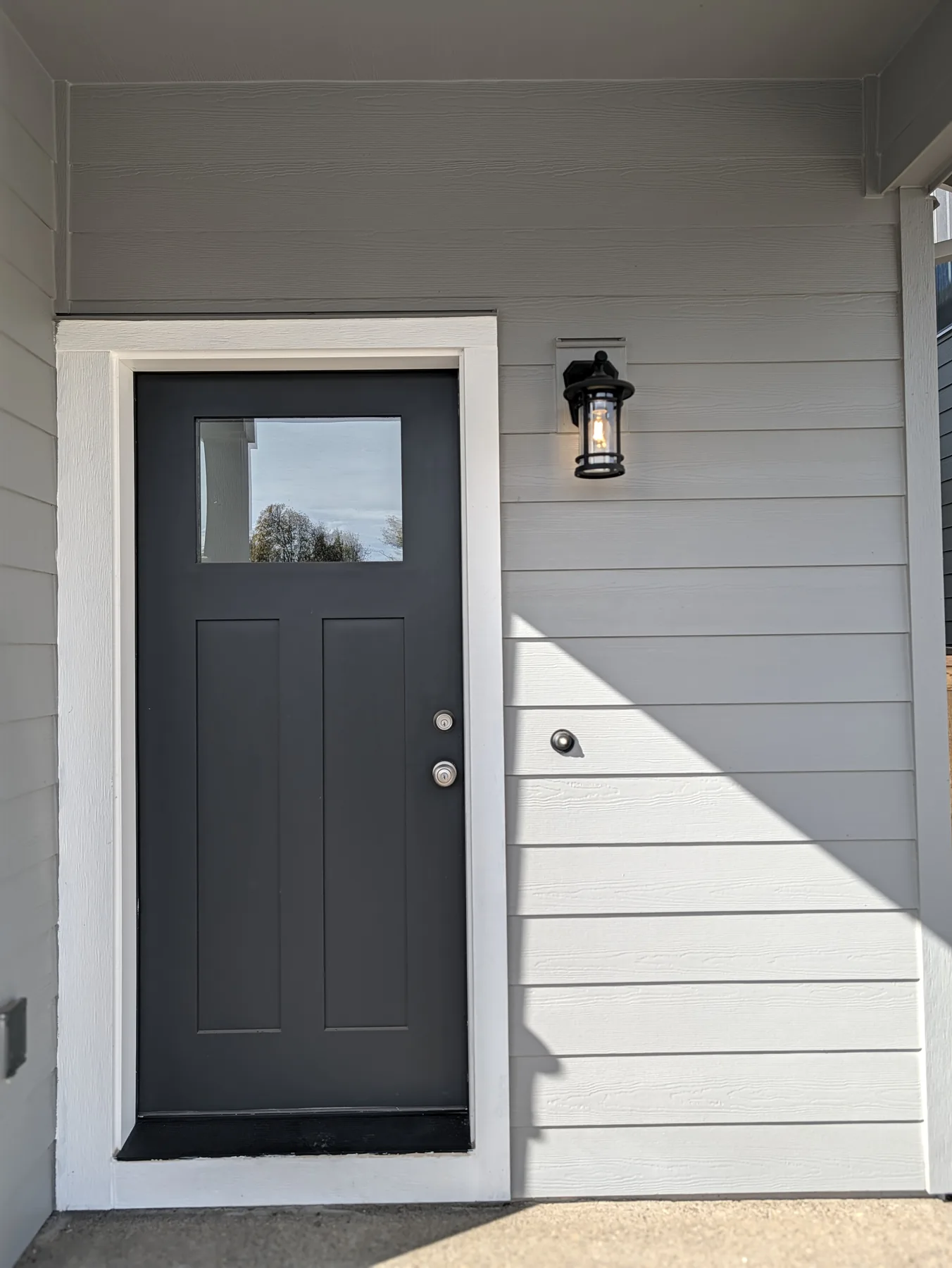
With a good circuit in place, the fun part is the fixture. On lap siding we mount the box on a flat block so the fixture sits square and the seal holds, and we caulk the top edge so water runs past instead of in. The switch goes where you naturally reach when you open the door, which is not always where the old one was.
A few owners want the light to manage itself. A photocell turns it on at dusk and off at dawn. A motion sensor suits a side door or the path to the garage. A timer switch fits somewhere in between. All of them work fine on a properly wired circuit, and none of them behave well on a flickering one, which is one more reason to fix the circuit first.
Thinking about new outdoor lights?
Call Brandon at (541) 220-0295 or use the contact page. Tell us which fixture you want to change and we will open the box and tell you what is behind it. You can see outdoor and finish work in our gallery and the full service on our residential wiring services page.
Common Questions
Can I hang a new porch light on the old wires myself?
On an old house we would hold off until someone opens the box. If the wiring is knob-and-tube or brittle cloth cable, handling it to make new connections can crack the insulation, and a heavier modern fixture may not suit a shallow old box. Send us a photo of the fixture and of your panel or fuse box, and we can usually tell you from that whether it is a simple swap.
Will my old panel have room for a new outdoor circuit?
Often it does, and when it does not, there are usually options short of a new panel. We check for open breaker spaces, the overall load on the house and the condition of the panel itself. If it is a fuse box or full of crowded connections, we will say so and explain what adding a circuit would involve before we start anything.
Will an LED bulb stop my porch light from flickering?
Sometimes it hides the problem for a while, but it rarely fixes it. A flicker that comes and goes with other appliances usually points to a loose connection or a shared, overloaded circuit, and some LED bulbs flicker more on old dimmers or worn switches. If the light flickers no matter what bulb is in it, have the circuit looked at.
Want better light at the front door?
You get Brandon and his son on the job, no subcontractors and no call center, with 11+ years of the founder’s experience behind every circuit. We give you a free quote with the price up front.