Maintenance
A Panel Checkup Before the Heaters Come On
Nobody calls an electrician about a panel that works. That is exactly why a scheduled checkup makes sense in an older Brownsville house, and why late fall is a good time for it. The space heaters come out of the closet, the baseboards wake up, the holiday lights go on the porch, and a panel that coasted all summer starts carrying its heaviest load of the year. I am Brandon. My son and I run Hub City Electric out of Albany, and this is what a maintenance visit covers on a panel with nothing obviously wrong.
Why the start of the heating season
Heat is the biggest steady load most houses carry. Electric baseboards, a heat pump working hard, a couple of space heaters in drafty rooms, an electric blanket on every bed. Those loads run for hours at a time, every evening, for months. A connection that has loosened a little over the years can sit quietly through summer and start warming up once winter puts real current through it.
Older homes add their own twist. Circuits in a heritage house were often added one at a time, so the heaviest winter loads may share a breaker with things that were never meant to sit beside them. Checking before the cold settles in means we see the panel at the start of its hard season instead of after something trips at the worst moment. It is a short visit, and most of the time the answer is that everything is fine and here is how to keep it that way. Our Brownsville panel maintenance page has the full scope.
Cover off: what we actually check
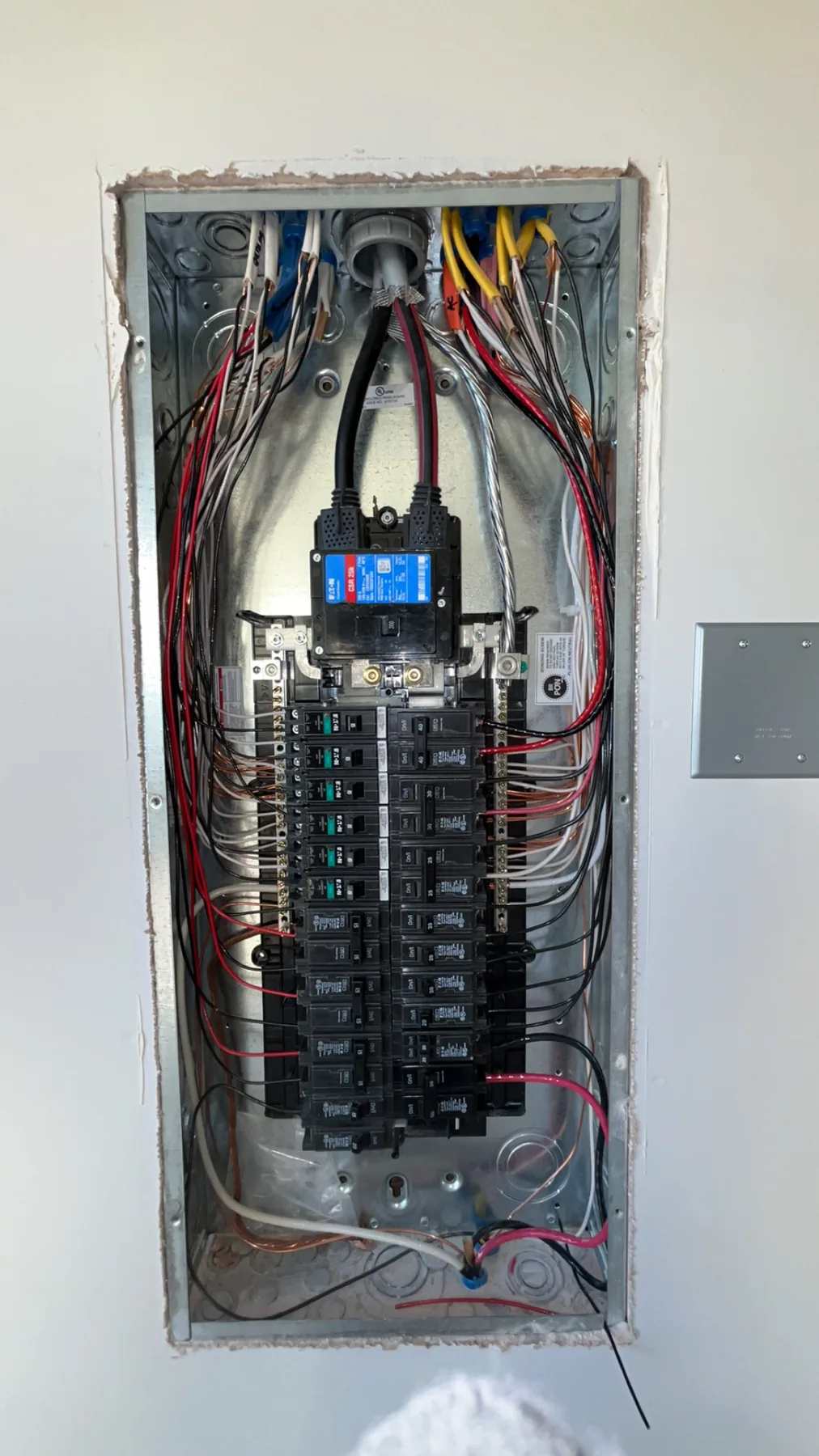
With the dead front removed and the power still on where it is safe to leave it, we work through the panel slowly.
- Heat marks. Discolored breakers, darkened insulation near a lug or a bus bar with a brown tint around one slot.
- Terminations. Screws that have backed off, wires sitting loose under a lug, and neutral and ground bars crowded past what they were made for.
- Corrosion. Rust or white powder on the bus or the lugs, which usually means moisture is finding its way in.
- Double taps. Two wires under a single breaker screw that was made for one.
- Old conductors. Aluminum branch wiring or cloth-jacketed cable arriving at the panel, which needs different attention at the connection.
We also ask you to run a couple of the big winter loads while we look, so we see the panel carrying the kind of current it will carry every evening from now until spring. A breaker that feels warmer than its neighbors under load tells us more than one sitting idle. Then we shut off the main to check the terminations themselves.
A panel rarely fails without warning. The warning is usually just behind a cover nobody has taken off in years.
The test buttons nobody presses
Many houses have GFCI outlets in the kitchen and bathrooms, and some newer circuits have GFCI or AFCI breakers in the panel itself. Every one of those has a test button, and in most homes we visit nobody has ever pressed it.
We press them. A GFCI or AFCI device that does not trip on its own test button is not protecting anything, and they do wear out. Any that fail get replaced. We also show you where each one is, so you know which outlet to reset when the bathroom goes dark, and so you can press the buttons yourself now and then. It takes a minute and it is the simplest piece of electrical maintenance a homeowner can do.
While we are walking the house to find those outlets, we look at how the winter loads are plugged in. A space heater on a power strip, an extension cord running under a rug to the bedroom, the holiday lights and the heater sharing one outdoor outlet. None of that shows up at the panel, and all of it is easy to fix once someone points it out.
A directory that matches the house you live in
Picture the first real storm of the season. The lights go out, come back an hour later, and one bedroom stays dark because its breaker tripped on the restart. In a lot of older Brownsville homes the directory on the door is no help at that moment: half the labels are blank and the rest name rooms the way a previous owner used them.
During the checkup we trace circuits and rewrite the directory to match the house as it is today, by room and by the big appliances. It sounds like a small thing until the first winter storm knocks the power out, a breaker trips when it comes back, and you are standing at the panel with a flashlight. A directory you can trust turns that into a quick fix. It also makes life easier for any electrician who works on the house later, us included.
Winter loads the panel has to carry
Heating season is when a house asks the most of its panel, and the strain usually shows up in the outlets before it shows up on the breakers. A space heater pulls close to what a whole general circuit is meant to carry, so a second heater, a dehumidifier or a kettle on the same run is often what starts the tripping people call us about in December. We look at which rooms get heated with plug-in units and which circuits those outlets share, and we tell you which pairings to avoid.
Outdoor outlets get the same look. Holiday lights, a block heater for the truck and a heat tape on the well line can all end up on one exterior receptacle that was put in for a hedge trimmer. If the checkup turns up something that maintenance cannot fix, such as scorched parts or a Federal Pacific or Zinsco panel, which are a known fire risk, we say so and point you to our panel installation work in Brownsville. The decision stays yours.
Want your panel looked at before winter?
Call Brandon at (541) 220-0295 or use the contact page. Tell us how old the house is and what heats it, and we will set up a checkup. You can see finished panels in our gallery and the full service on our residential panel maintenance page.
Common Questions
Is it safe for me to take the panel cover off and look?
We would rather you did not. The door on the front is fine to open and the breakers are fine to flip, but the cover behind it exposes live parts even with the main off, because the wires coming in from the utility stay energized. If something looks or smells wrong, take a photo with the door open and send it to us instead.
My AFCI breaker keeps tripping. Is the breaker bad?
Sometimes, but more often it is doing its job. An AFCI breaker trips when it sees arcing, which can come from a damaged cord, a loose outlet, a nail through a cable or an old vacuum motor. We look at what is plugged in and test the circuit before blaming the breaker. Replacing it with a standard breaker to stop the tripping is never the fix.
Does a newer house need a panel checkup too?
Less often than an older one, but it does not hurt, especially after an addition, a new heat pump or a hot tub. Connections can settle in the first years, and any added circuits are worth a second look. On a newer house the visit is usually quick and mostly confirms the panel is in good shape.
Has anyone looked inside your panel lately?
You get Brandon and his son on the job, no subcontractors and no call center, with 11+ years of the founder’s experience behind every checkup. We give you a free quote with the price up front.