Panels
Read the Directory Inside Your Panel Door
Open the door on your panel and look at the paper card taped inside it. That card is the closest thing your house keeps to a written history, and most of them are worth reading. Faded pencil in one hand, ballpoint in another, a line crossed out and rewritten, two positions labeled the same room, four positions labeled nothing at all. I am Brandon, and I run Hub City Electric with my son out of Albany. Before we ever talk about replacing a service, we read that card, because it tells us more about how a house grew than any conversation does.
Handwriting is a timeline
A directory written in one hand, in one pen, in one sitting, means somebody labeled the panel when it went in and nobody has touched it since. That is usually good news. It means the circuits are the circuits, nothing has been added blind, and what you see is what the house has.
Three or four different hands tell a different story. Somebody added a circuit for a shop, somebody else fed an addition, a third person put in a bathroom and squeezed a breaker in wherever there was room. Each of those people knew what they were doing at the moment they did it, and none of them knew what the others had done. That is how a panel ends up with two positions labeled kitchen and neither of them feeding the kitchen.
Blank positions are the ones that make us curious. A breaker with nothing written beside it is either feeding something nobody in the household remembers, or feeding nothing at all because a circuit was abandoned when a wall moved. Both are common. Neither is dangerous by itself. Both are worth resolving, because a breaker nobody can identify is a breaker nobody will dare shut off during an emergency.
What the physical box tells us next
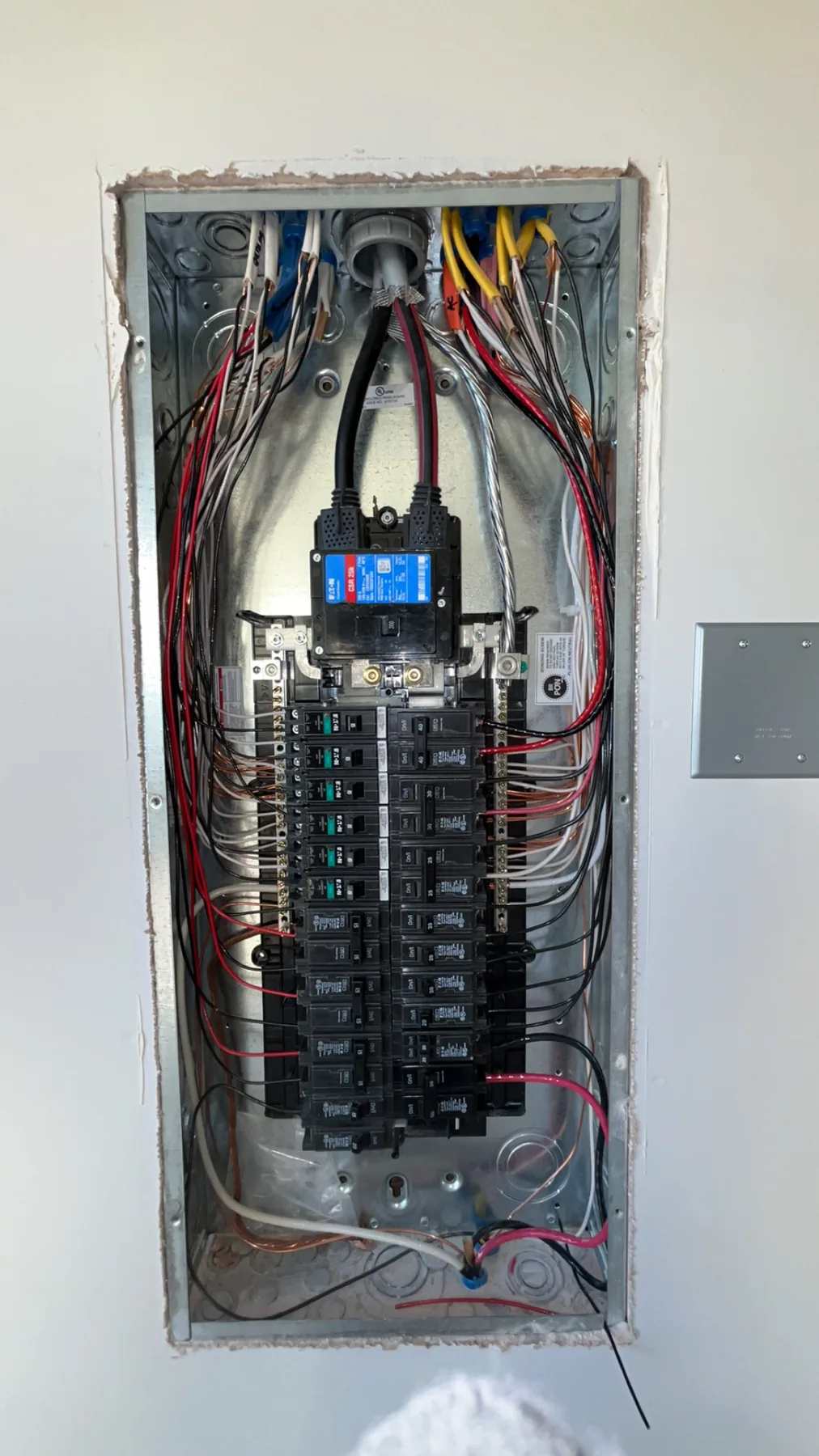
After the card comes the hardware. We are looking at whether every position is occupied, whether anything has been doubled up to make room, whether the cover screws still line up with a cover that belongs to this box, and whether the label on the inside of the door matches the brand on the front of it. Mismatches happen more than you would guess.
Rust anywhere inside is a flag, and it usually points somewhere else entirely. Water arriving in a panel came from a conduit that runs uphill from a wet place, or from a meter base that has lost its seal, and chasing the stain back to its origin matters more than cleaning it. Scorching or a smell like hot plastic is a same-week call, not a someday call.
Then we look at what feeds it. The conductors coming down, the mast outside, the meter base, the grounding at the water line or the ground rod. A box on the wall is the visible portion of a system, and the parts nobody photographs are frequently the parts doing worse. Any of that changes the shape of the job, which is why the walkthrough happens before the number does.
A breaker nobody can identify is a breaker nobody will shut off when it matters.
Why an old panel rarely announces itself
People expect a failing service to misbehave. Mostly it just sets a limit, and the family adjusts to that limit so gradually that nobody notices they have adjusted. Laundry waits until the shop heater is off. The window unit and the microwave never run together, and that has been true so long it feels like a house rule rather than a symptom.
The moment those arrangements stop working is almost always the moment something big changes. A water heater dies and the replacement is electric. A furnace gets swapped for a heat pump. A vehicle shows up that expects to charge overnight. Suddenly the room in the box that everyone assumed was there turns out never to have existed.
That is the honest reason to look at a panel early rather than during a crisis. A planned service change is a scheduled day with a written price. The same work done in a hurry because the water heater failed on a Friday is the identical job with worse timing and fewer choices. Our full walk through of that work sits on the Lebanon panel upgrade page.
Where the older housing sits in Lebanon
Lebanon has a working historic downtown, and the housing nearest that core is exactly where the interesting panels turn up. Those homes were wired for households that owned very little that plugged in, and the additions since then have arrived in layers. On those streets we expect to find a fuse assembly or a small box with a subfeed hanging off it, and we are rarely wrong.
The newer parts of town, filled in as Lebanon has kept growing, ask a different question. Those services are typically large enough already, so the useful conversation becomes whether a subpanel in the garage or the shop solves the problem without touching the main at all. That answer is cheaper and faster, and we would rather give it to you than sell a service change nobody needs.
Reading what is on your wall costs nothing either way. Lebanon is a short run east of our shop, so getting out to look is easy, and we would rather tell you your panel is fine than talk you into work that does not improve anything. If it needs the change, you get the price in writing before we order a part.
What a good directory looks like when we leave
Every panel we finish gets a directory somebody else can actually use. That means each position identified by room and by what it feeds, not by a word like miscellaneous. It means the dedicated circuits named for their appliance so nobody guesses in a hurry. It means legible printing rather than the pencil scrawl we so often inherit.
It sounds like a small thing. It is the difference between a household that can kill power to one bathroom in fifteen seconds and one that shuts the main off to change a light fixture. It is also the first thing a home inspector reads, and the thing a buyer’s agent notices without being able to say why the panel felt cared for.
We label as we land circuits rather than at the end of the day from memory, which is the only way the card ends up true. Then the permitted work goes on the Linn County record, so what we did is documented rather than merely done, and you keep both the card and the paperwork. Everything else we handle at your house is on the Lebanon residential page.
The short version
Go look at the card in your panel door this week. If it is legible, current and complete, your house is in reasonable shape. If it is four hands of pencil with blanks in the middle, call Brandon at (541) 220-0295 or use the contact page, and we will come read it with you.
Common Questions
Can I relabel the directory myself?
You can, and it is worth doing if the card is a mess. Work one breaker at a time with somebody in the house calling out what went dark, and print rather than write. What you cannot safely do is open the cover to trace wiring inside the box, because the main lugs stay live even with the main breaker off. Labeling from outside the cover is the safe version.
Does a full panel automatically mean I need a service change?
No. Full and undersized are separate problems. A panel can be out of physical positions while the service feeding it has plenty of capacity, and in that case a subpanel or a tandem arrangement solves it for far less. The load calculation is what settles which situation you are actually in, so we do that before recommending anything.
How do I know if my panel brand is one of the problem ones?
Certain lines from decades back have a poor record of tripping when a fault calls for it, and the brand is printed on the panel front or inside the door. Send us a photo and we will tell you what you have. If it is one of those, we will show you what is in your box and explain what we recommend rather than leading with alarm.
Want somebody to read your panel?
No call center, no runaround. You get Brandon and a small Oregon crew that has been doing this for 11+ years. Reach us for a free quote with a clear timeline and a price up front.